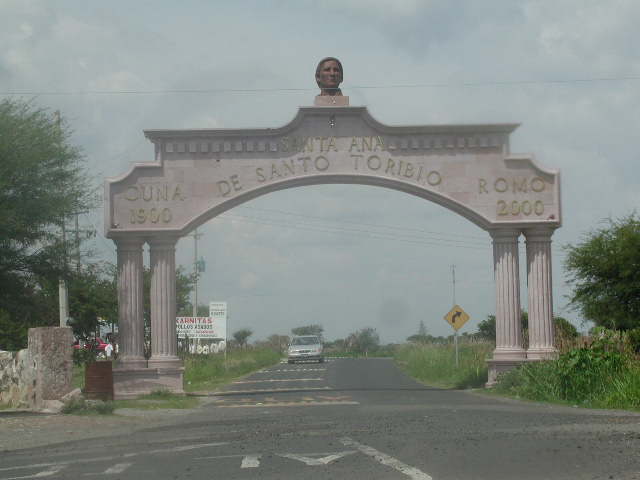
How to get there, what to see, when to go. A village of 324 inhabitants that receives one million pilgrims a year — a complete practical guide for those who want to visit the resting place of the patron of migrants.
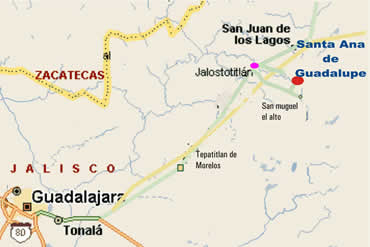
Santa Ana de Guadalupe is a ranchería — a small rural settlement — in the municipality of Jalostotitlán, in the Los Altos region of Jalisco. It lies 11 kilometers northeast of the municipal seat, 30 minutes by car from the Marian shrine of San Juan de los Lagos, and about two and a half hours from the center of Guadalajara. The altitude is 1,819 meters (5,968 feet) above sea level, giving it a temperate-dry climate most of the year, with cool nights even in summer.
21.1077° N, 102.4157° W
Open in Google Maps →
The settlement had fewer than two hundred inhabitants when Toribio was born in 1900. Today it has about 324, and the number remains stable — the villagers have seen their community, without growing in population, become the third most important pilgrimage destination in Jalisco, after the Tepeyac basilica in Mexico City and San Juan de los Lagos. Its only real industry, for the past thirty years, has been pilgrimage.
The shrine complex was built in stages starting in 1997 under the direction of Father Gabriel González Pérez, rector of the sanctuary for more than twenty years. The layout is almost linear: the pilgrim enters by the Calzada de los Mártires (Walkway of the Martyrs), reaches the Iglesia de la Mesita — the original chapel that Toribio himself helped to build — passes through the new main shrine with the saint's relics, and can end at the reconstructed birthplace and museum.
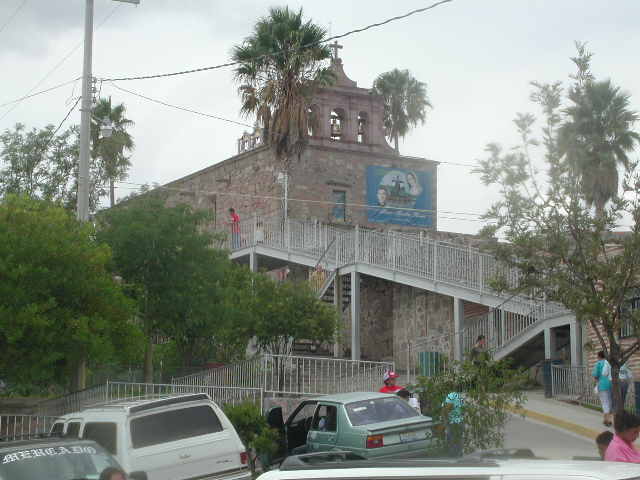
This is the original chapel. A commemorative plaque on its walls records the history with precision: «On February 11, 1920, the first stone of this temple was blessed and laid. On January 5, 1923, at dawn, the last of the vaults was closed, a few hours before the newly ordained priest Toribio Romo sang his first Mass here. The ranch of Santa Ana was dedicated to the Virgin of Guadalupe, and that is why this little hill called the Mesita was chosen so that here would be her Tepeyac.» The construction of this temple was, for the villagers, the ambitious expression of a poor ranchería deciding to have its own Marian pilgrimage site — seven years before anyone imagined that the young priest who would officiate there would end up elevated to the altars.
Many pilgrims prefer to pray here rather than in the large new shrine. The space preserves the intimate atmosphere of the original cult: stone walls, wooden pews, restored gilded retablos, and the saint's relics — the bloodstained clothing he wore at death, the scapular, a small vial of blood gathered from the body — are displayed in side urns accessible to view.
Designed by architect Brother Gabriel Chávez de la Mora and built between 2012 and 2020, it has capacity for two thousand seated faithful and several thousand more standing on the outside esplanade. It houses the main urn with the saint's remains, which were transferred from the Iglesia de la Mesita to the main altar of the new shrine on January 6, 1998 — a date commemorated by a bronze plaque on the side wall.
A paved walk flanked by busts of the 25 martyrs canonized in 2000 — Cristóbal Magallanes and companions — connecting the entrance of the complex with the shrine. Walking along the Calzada is itself a form of preparation for the visit: each bust bears the name and dates of the corresponding martyr. Toribio Romo occupies a prominent place near the end of the route.
A reconstruction within the shrine grounds. Two small adobe rooms, period household objects, kitchen utensils, a wooden bed like the one the Romo family had. It is a symbolic space. The original house, even more modest, is preserved separately in the old heart of the village, marked but not ordinarily open for interior visits.
A small museum dedicated to the Cristeros, the canonization, and Toribio himself. It preserves, among other objects, the mesquite tree under which Toribio gave catechism as a child — now under a protective roof.
Three dining rooms run by the parish offer home-cooked food — carnitas, birria, fried tacos, rompope — at affordable prices (between 40 and 100 Mexican pesos, roughly $2–$5 USD, per plate). Six shops sell holy cards, medals, rosaries, and devotional material. Restrooms are free and kept clean. There is ample parking on ordinary days and three additional fields used on major pilgrimage dates.
The shrine is well connected to western Mexico. All routes converge at Jalostotitlán; from there, eight kilometers (five miles) of paved road lead to Santa Ana de Guadalupe. If using GPS navigation, enter «Santa Ana de Guadalupe, Jalostotitlán, Jalisco» or use the coordinates 21.1077, -102.4157.
Aguascalientes airport (AGU) is a useful alternative to Guadalajara for visitors arriving from the United States.
Inspired by the Camino de Santiago de Compostela in Spain, the Jalisco State Tourism Department designed a religious pilgrimage circuit linking the shrines of the main Cristero martyrs with the great Marian sanctuaries of Los Altos. Many pilgrims — especially organized groups from the United States — walk the whole route in three or four days rather than visiting Santa Ana in isolation.
The main points of the Cristero Route, in order of proximity to Santa Ana:
Agencies like Cristeros Tour and Ruta 21 offer organized packages of 3 to 5 days that include transportation, lodging, concelebrated Masses, and certified guide. For independent pilgrims, the route can be done on one's own with a rental car — the itinerary is direct and state signage is present at all highway exits.
The shrine is open 365 days a year, with Masses every hour between 7:00 a.m. and 7:00 p.m. during high seasons, and less frequently on ordinary days. Always verify schedules with the rectory before traveling. Major pilgrimage dates concentrate tens of thousands of people and require different logistical preparation.
Official memorial of Saint Cristóbal Magallanes and 24 Mexican martyr companions, the group in which Saint Toribio is included. The shrine fills to capacity; concelebrated Masses are held outdoors, processions with relics take place, and the Archbishop of Guadalajara presides. It is recommended to arrive a day early and lodge in San Juan de los Lagos or Jalostotitlán.
Solemn Mass for the anniversary of Father Toribio's death. Less crowded than the May feast, more meditative, often falling during Lent, which gives it a penitential tone. A good time for a visit with a small group.
Anniversary of Toribio's birth in 1900. Local, intimate occasion. Descendants of the village of Santa Ana usually gather for Mass and community meal. Family atmosphere.
The original chapel was dedicated to Our Lady of Guadalupe — «this little hill called the Mesita so that here would be her Tepeyac», the founding plaque says. The shrine fills with celebration. It is also when many migrants return from the United States to visit family, filling the shrine with transnational pilgrimage.
Popular devotion specially associates Tuesdays with Saint Toribio Romo. Although the official feast is in May and the martyrdom occurred on a Saturday, Tuesdays bring increased pilgrim turnout, many families light yellow candles, and the shrine usually offers a votive Mass of the saint.
Los Altos de Jalisco has a temperate-dry climate. Daytime temperatures between 18°C and 28°C (65–82°F) most of the year, with cool nights (dropping to 5°C / 41°F in winter). Bring warm clothing if traveling between November and February, even on sunny days. In summer (May through September) bring a hat — the sun at 1,800 meters is intense — and sunscreen. Rainy season runs July through September.
Modest dress. Men: long pants and a shirt with sleeves. Women: dress, skirt below the knee, or pants; blouse with sleeves; many women pilgrims bring a scarf or rebozo to cover their head during Mass, though it is not required. No shorts, Bermuda shorts, or sleeveless tops inside the temple.
Bring bottled water. The shrine has dining rooms and sells fresh drinks, but on high-traffic days lines are long. If traveling with children or older adults, bring your own water and a light snack for between visits. The altitude (1,819 meters / 5,968 feet) can cause more fatigue than expected for visitors from sea level.
The village has one ATM, but it is small and runs out of cash on festival days. Bring Mexican pesos in cash from Jalostotitlán or San Juan de los Lagos. The shrine's dining rooms and shops accept cash; some take cards with a surcharge.
Silence inside the temple. No photography during Mass without explicit permission. General photographs of the interior are allowed outside liturgical time. Do not touch relics or altar objects. Children welcome, but keep them from running inside.
Santa Ana de Guadalupe is a small village with no hotels of its own. For lodging, we recommend:
Two hours from Santa Ana — 150 kilometers by highway crossing Guadalajara — is the ranch of Agua Caliente, on the outskirts of Tequila, Jalisco. Here, in the abandoned tequila distillery owned by Mr. León Aguirre, Father Toribio spent his last five months in hiding, and here he was murdered at dawn on February 25, 1928.
The site is visited as an extension of the Santa Ana pilgrimage. It is less visited, less infrastructured, more contemplative. A modest chapel marks the exact place of the martyrdom. A signposted hiking trail about one hour long connects with the Mirador del Chiquihuitillo and offers panoramic views of the region.
For those who make the complete pilgrimage — Santa Ana where he was born and rests, Agua Caliente where he died — the contrast is important. Santa Ana is celebration, crowd, thanksgiving; Agua Caliente is silence, ravine, memory of the exact moment when a twenty-seven-year-old man was shot while trying to rise from his bed.
For those preparing to travel, or those commending a pilgrimage of their own or a loved one, our archive offers traditional prayers, a nine-day novena, and the specific prayer of the pilgrim.
See prayers →